Bond Angle O3. And for f2o , the atomic size of f is very small (smaller than o) , and its electronegetivity is also greater than o. How is bond angle determined?
O3 Molecular Geometry On Haircuts from www.onhaircuts.com
According to the valence shell electron pair repulsion theory, a trigonal planar molecular geometry is expected with an f. Now we just have to decide whether $\ce{h2o}$ or $\ce{h2s}$ has a smaller bond angle. So the correct order of increasing bond angle is.
$\Ce{H2O}$ And $\Ce{Nh3}$ Are Hydrides Of The Same Period So We Can Use The First Rule To Determine That $\Ce{H2O}$ Has A Smaller Bond Angle.
According to the valence shell electron pair repulsion theory, a trigonal planar molecular geometry is expected with an f. The oxygen has four regions of electron density in total, but for molecular structure we only look at the two regions that have bonded atoms. Co2, h2s, ncla 0 o3.
So The Correct Order Of Increasing Bond Angle Is.
Sf2 has a bond angle slightly less than 109.5 degrees due to its sp3 hybridization. The bond angle n o 2 + , n o 2 , and n o 2 − are 1 8 0 ∘, 1 3 4 ∘ a n d 1 1 5 ∘ respectively n o 2 + , and n o 2 − undergoes, s p and s p 2 hybridization respectively. Rank the following molecules according to increasing bond angle:
It Has Eight Valence Electrons.
The bond angles for the molecules having a tetrahedral geometry is 109°, but as the geometry of h 2 o molecule is distorted due to the presence of the lone pairs of electrons, the bond angle decreases from 109° to 104.5° h2o shape. So the bond angle is 103°. Repulsion causes the bond angle to come to about 116 degrees.
So The Bond Angle Becomes 109.5° (Almost 110°).
And for f2o , the atomic size of f is very small (smaller than o) , and its electronegetivity is also greater than o. How is bond angle determined? The ideal bond angle is 109.5, but because that lone pair is there, all you'd have to really say is, you would expect the bond angle to be less than 109.5.
In The O3 Lewis Structure,There Is A Double Bond Between Central Oxygen Atom And One Lateral Oxygen Atom.
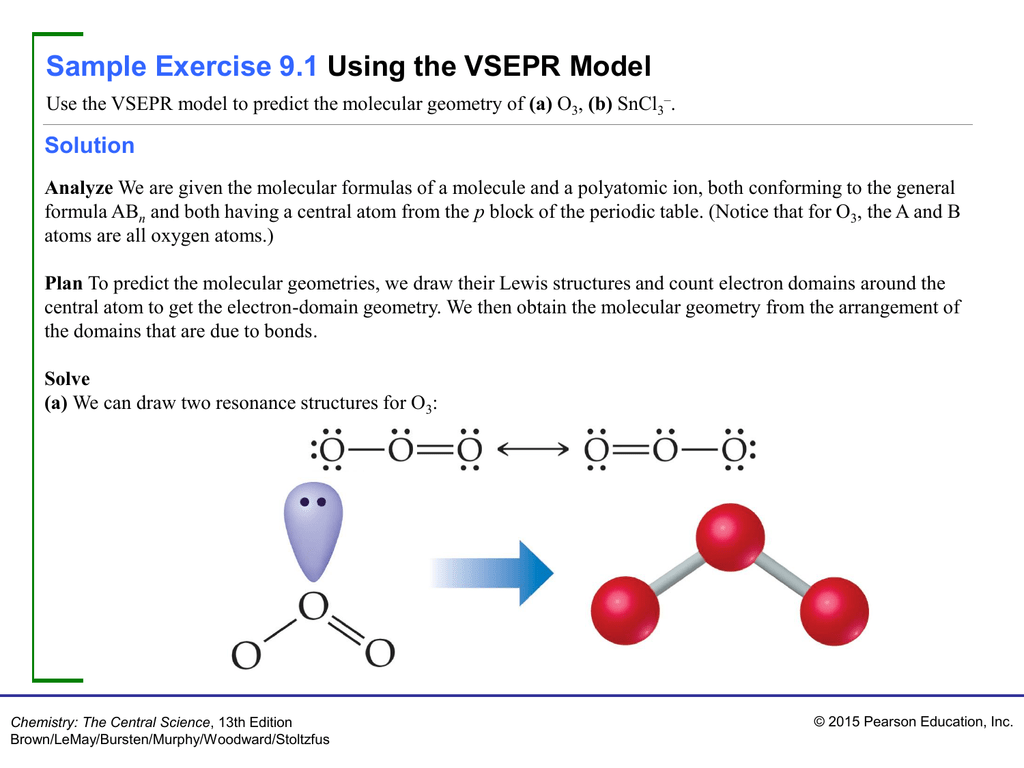
The trioxygen molecule o3 has one lone pair and forms a bent shape with bond angles of 118 degrees. The ozone molecule is found to be bent trigonal planar shape due to the presence of resonance. This problem has been solved!