Use The Data Given Below To Construct A Born Haber Cycle To Determine The Electron Affinity Of Br. K (g) → k⁺ (g) + e⁻ 419. For the reaction to proceed, k is to be converted to the gaseous state.
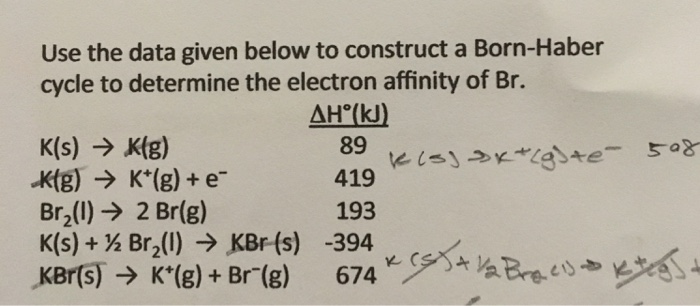
A) lattice energy b) electron affinity c) heat of formation 3. For the reaction to proceed, k is to be converted to the gaseous state. Dh° (kj) k (s) → k (g) 89.
Let's Take #Nacl# As An Example.
½ br 2 (l) → br (g) 96. Split ½ o 2 (g) into o (g) atoms. The given reaction is the formation of kcl.
K (G) → K⁺ (G) + E⁻ 419.
Asked aug 16, 2019 in chemistry by tesla. Dh° (kj) k (s) → k (g) 89. Use the following data to calculate the lattice energy of calcium oxide.
Δh° (Kj) K (S) → K (G) 89.
Ah (kj/mo) sublimation of calcium 193 first… Kbr (s) → k⁺ (g) + br⁻ (g) 674. Asked aug 2, 2019 in chemistry by yesiamready.
Answered Aug 2, 2019 By.
For the reaction to proceed, k is to be converted to the gaseous state. We review their content and use your feedback to keep the quality high. Step 3 convert ca + (g) into its ion, ca + 2 (g).
Br2 (L) → 2 Br (G) 193.
Convert ca (g) into its ion, ca + (g). In a cycle, the net energy of the reaction can be calculated. Convert ca (s) into a gas, ca (g).
