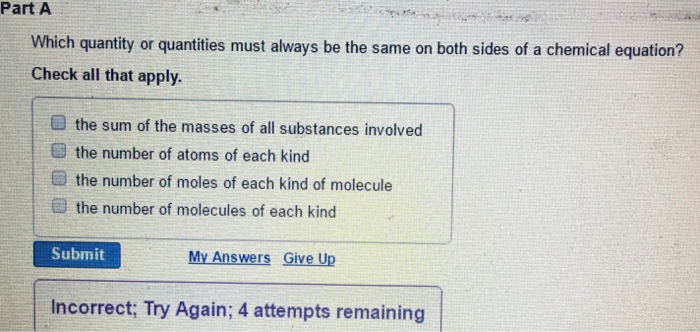
Which Quantity Or Quantities Must Always Be The Same On Both Sides Of A
Chemical Equation
Which Quantity Or Quantities Must Always Be The Same On Both Sides Of A Chemical Equation. The heat capacity of the calorimeter must be determined experimentally. Waves can be periodic, in which case those quantities oscillate repeatedly about an equilibrium (resting).
Solved Which Should I Choose For This Q Clear Answer Not from www.chegg.com
The heat capacity of the calorimeter must be determined experimentally. By taking the square root of both sides of the equation, the time of flight can then be determined. Results of leaching tests on three soils in iraq (dieleman, 1963) presented in figure 1 show the effect of soil type on the quantity of water required to achieve the same extent of leaching.
In Physics, Mathematics, And Related Fields, A Wave Is A Propagating Dynamic Disturbance (Change From Equilibrium) Of One Or More Quantities, Sometimes As Described By A Wave Equation.in Physical Waves, At Least Two Field Quantities In The Wave Medium Are Involved.
By taking the square root of both sides of the equation, the time of flight can then be determined. The heat capacity of the calorimeter is the quantity of heat absorbed by the calorimeter for each 1°c rise in temperature. Of the calorimeters always absorb some energy from the system.
Results Of Leaching Tests On Three Soils In Iraq (Dieleman, 1963) Presented In Figure 1 Show The Effect Of Soil Type On The Quantity Of Water Required To Achieve The Same Extent Of Leaching.
0.122 s 2 = t 2. Waves can be periodic, in which case those quantities oscillate repeatedly about an equilibrium (resting). The easiest process is to study the mixing of warm and cold water.
The Heat Capacity Of The Calorimeter Must Be Determined Experimentally.
Results of one such test (khosla et al., 1979) are presented in figure 2 (a and b) and some of the soil characteristics of the experimental site are given.