Whats The Difference Between Polar And Nonpolar Covalent Bonds
Whats The Difference Between Polar And Nonpolar Covalent Bonds. 4 rows the prime difference between polar and nonpolar solvents is, the polar solvent gets dissolved in. A covalent bond in which the bonding electrons are shared equally between the two atoms.
Covalent bonding from www.slideshare.net
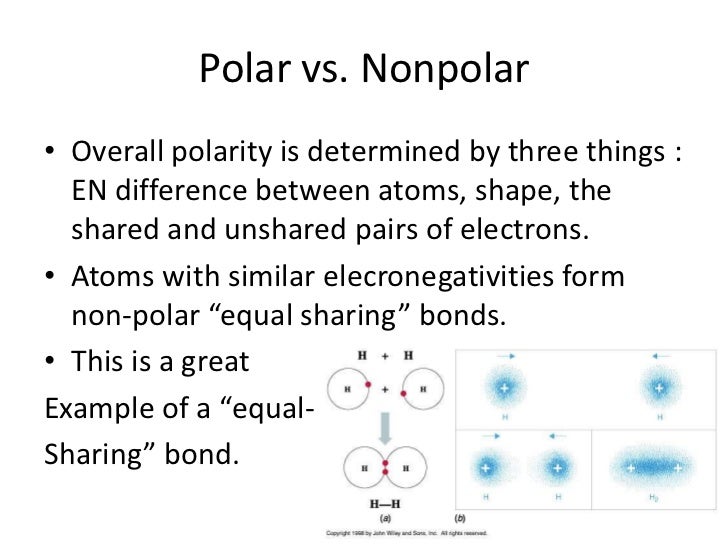
• in non polar covalent bonds, electrons are equally shared by the two atoms participating in making the bond. The result is a bond where the electron pair is displaced toward the more electronegative atom. A covalent bond in which the atoms have an unequal attraction for electrons and so the sharing is unequal.
Polar Covalent Bonds Occur Between Two Nonmetals That Are Different Types Of Atoms.
Because all atoms have different electronegativities, the only time you would have a nonpolar covalent bond is when. If the result is between 0.4 and 1.7, then, generally, the bond is polar covalent. Ionic bond = full transfer of a valence electron.
4 Rows The Prime Difference Between Polar And Nonpolar Solvents Is, The Polar Solvent Gets Dissolved In.
Lesson summary nonpolar covalent bonds are a type of chemical bond where two atoms share a pair of electrons with each other. The electron cloud of a polar bond is distorted. So the electron sharing is not equal.
Polar bonds are covalent bonds between elements that have different electronegativity. What determines if a covalent bond is polar? Bonds that are partly ionic are called polar covalent bonds.
A Nonpolar Covalent Bond Is Between 2 Hydrogen Atoms Because They Evenly Share The Electrons.
A covalent bond in which the bonding electrons are shared equally between the two atoms. Nonpolar covalent bonds form between two atoms of the same element or between different elements that share electrons equally. Polar covalent bonds occur when there is a difference in electronegativity, or electron affinity, between covalently bonded atoms.
Polar Covalent Bonding Is A Type Of Chemical Bond Where A Pair Of Electrons Is Unequally Shared Between Two Atoms.
9 rows the major difference between polar and nonpolar is polar bonds are asymmetrical whereas. The rule is that when the electronegativity level is greater than 2 the bond is considered ionic. Polar covalent bonds are relatively weak when compared nonpolar covalent bonds.